Member Spotlight: Randi Burlew
Aug 29, 2026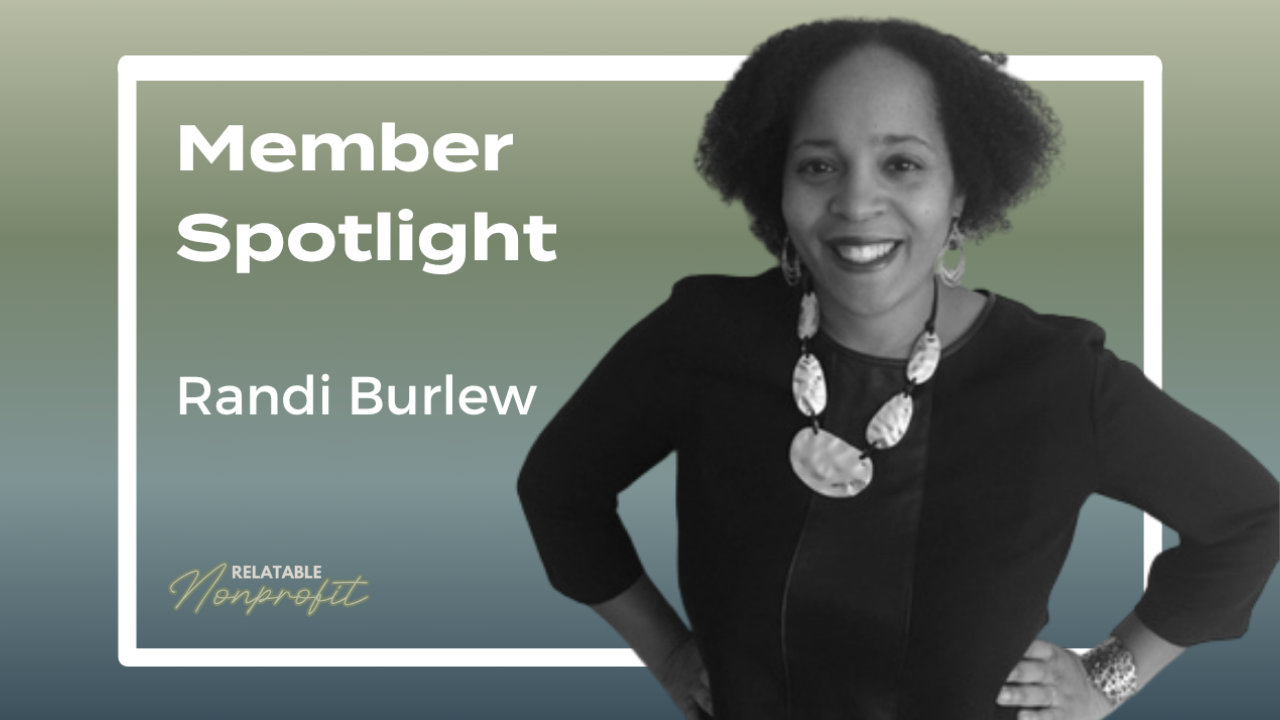
Member Spotlight: Randi Burlew, Community-Centered DEIJ and Equity Strategy
Tell us who you are, who you serve, and what you’re focused on right now.
I founded The Burlew Group in 2019 to support my work consulting with organizations about how to best meet their DEIJ goals. This was in response to repeated requests that began coming in from my network asking for assistance and consulting with projects that relied on having strong relationships with the communities they serve. This resonated with me because one of the things that I had seen over and over again is that many of the nonprofit organizations that I worked with struggled to connect with the communities they served in a meaningful and significant way. Instead, their relationships with these communities were narrowly focused on implementing programs, meeting targets, and reaching outcomes identified by their funders. And due to this, the needs and wants of the communities were getting lost. Additionally, the communities had very little power and influence in shaping the interventions being imposed upon their communities. People in my network were starting to realize that this needed to change. Luckily, it was also something I could help with.
The Burlew Group supports mission-driven organizations to create inclusive cultures and stronger partnerships with communities of color so they can attract and retain diverse talent and grow their impact. We can help your organization:
- Assess where you are on your DEI journey
- Set and work towards DEI goals
- Move from DEI intention to implementation
- Create stronger and more effective partnerships with the community you serve
- Implement DEI learning opportunities designed to transform your organizational culture
- Develop organizational and race equity strategic plans
- Develop and facilitate community advisory groups
What led you into this work? Share a specific moment or turning point.
I want to share with you a recent moment that really crystallized for me the fact that this focus on how to partner with communities of color is important. I have been working on a project with a Tribal organization in Northern California for about five years. They received funding from the federal government, and they hired me to do some research and consulting for the project. As part of the grant requirements, we attend a federal conference each year with other Tribal organizations and their consultants that receive the same funding. Last year at the conference, I was in a small discussion group, and among the participants were some grantees who, like me, are not Indigenous. During the discussion, they were lamenting about the fact that they could not get their project off the ground because the Tribal nation near them would not “cooperate” with them. During the discussion, the other members and I started asking some questions.
- When you were applying for the grant, did you work with the Tribal nation to ensure that they would partner with you on this work? The answer: no
- After receiving the grant, did you form a Tribal Advisory Group to help guide and oversee your work in the community? The answer: no
- Have you done research or spoken to families in the community about how they understand and experience childbirth and parenting? The answer: no
- Have you ever done work in a Tribal community before? The answer: no
This line of questioning went on for a few minutes. They had written this grant with the idea that they knew a lot about child development and could impose what they thought were the right interventions on the Tribal community. And predictably, it wasn’t working. Like many other organizations, they did not invest in building a partnership with the community, and that was the crux of their problems. A lot of organizations believe that because they have good intentions, they will have a good impact, and this is not the case. Sometimes, like the example I just talked about, they can’t get their projects off the ground; sometimes they implement a program, and it doesn’t work.
But worse than that, sometimes they implement a program, and it causes harm to the very communities they want to serve. For example, I have done a lot of work in the area of teen pregnancy prevention. There are a lot of strategies and curricula that have been designed to reduce teen pregnancy. In my career, I have evaluated several of these programs. And the truth is that many of them do not work for a wide range of reasons, and others only work with specific groups. On several occasions, I have evaluated the implementation of some of these programs, and when we look at the results, what we find is that after implementing the program, teen pregnancy rates have actually INCREASED, which means that a community that was already at an elevated risk for teen pregnancy is doing a lot worse than if the organization implementing the program had just left them alone. Usually, this happens because an organization chooses a program that is not a good fit for the community. The program worked in a different community or for a different group of people, but it is not the right approach for the community that they are currently working with. And if they had just partnered with the community, the community could have told them that. That is just one of the risks of not engaging the community as partners in your work.
What was one of the hardest parts of building your career or business, and how did you move through it?
The anti-DEI pushback in our current socio-political context has been incredibly difficult. Seemingly overnight, many of my clients lost contracts and had their work scrutinized through an extremely harmful anti-DEI lens. In some cases, that has meant that I have also lost contracts. In other cases, we are finding new ways to continue doing this important work. My passion for this work keeps me moving forward. In addition, I remind myself that DEI and justice work have never been popular. There has always been pushback. However, that has not stopped us from making progress. I believe that we can still make a lot of progress towards equity, even during this difficult time.
Describe a recent project, or client win you're proud of. What changed because of your work?
I spent a few years working with a mission-driven organization focused on child welfare. During that time, we were able to accomplish a lot of really important things. First, we were able to review all of the training that caseworkers and supervisors take through a race equity lens and make important and significant changes that will improve the experiences of children and families of color. I also facilitated a race-equity working group with child welfare leaders for two years. In addition to increasing knowledge, participants left with skills and ideas that can touch communities across the state.
What are you building or refining right now?
I am currently focused on helping philanthropic and mission-driven organizations partner better with the communities of color that they serve. This involves addressing organizational culture, changing harmful policies and practices, and sharing power with communities.
What belief about consulting or nonprofit work has changed for you over time?
I believe that the most important and sustainable work that any of us will ever do is investing in community leaders. These are the people who are most committed to the work, who have been navigating these challenges before our organizations arrived on the scene, and who will continue to work on these challenges once funding priorities change.
What practical advice would you give someone earlier in their journey?
Learn as much as you can from the communities you serve. Community members have been navigating these unjust systems to survive. Nobody knows these systems better than the communities that are disproportionately impacted by them every day.
Connect with Randi:
The 2026 State of Nonprofit Consulting Report
See what nearly 400 nonprofit consultants reveal about income, client work, business structure, and what makes consulting sustainable.