Member Spotlight: Erin Peshoff
Aug 10, 2026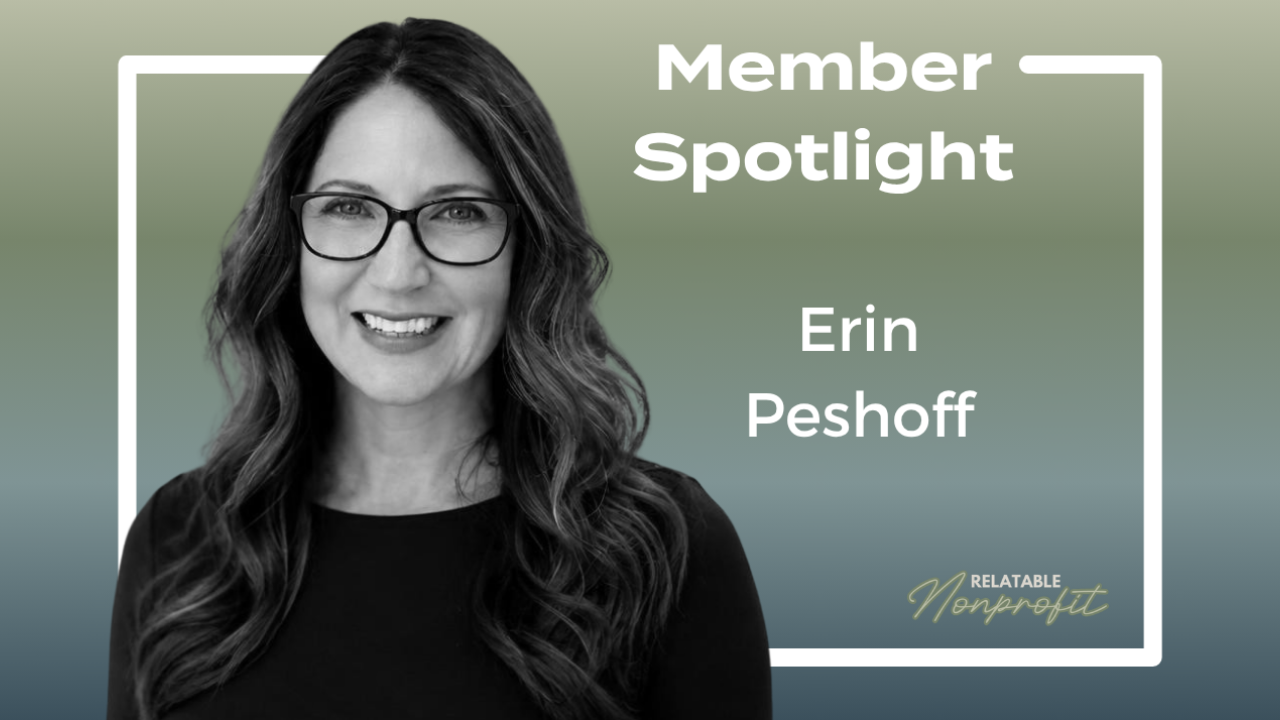
Member Spotlight: Erin Peshoff
Tell us who you are, who you serve, and what you’re focused on right now.
I am Erin Peshoff. I spent 28 years as a fundraiser, in nearly every chair the work has: frontline, leadership, consulting, software. Now I build the operations behind the mission instead of running it. At Vivid Operational Advisors I work with growing nonprofits whose systems have not kept up with their ambition. The pattern I see most is accumulation: years of tools and processes stacked on top of each other until the work weighs more than it should. My first move is always to edit, not add. Right now I am spending the summer in conversations with the kind of organizations that feel that weight and are ready to set some of it down.
What led you into this work? Share a specific moment or turning point.
The first real turning point was a choice not to do the thing I had spent my whole life preparing for. The plan was Chicago, a year of service at a girls' group home, my college roommates scattered to similar posts. I had been pointed at that kind of work since I was small. Then I graduated and realized I had not spent any real time with my sister, who was the same age as the girls I was about to go serve. I went home instead. The first thing I ever chose about this work was a choice to be present over a choice to follow the plan.
The door itself came a few years later, almost by accident. I was a year into a PR job I did not want, gluing press mentions onto paper and mailing them to clients. I was babysitting on the side for an old camp counselor's mom, and one night I told her what I actually wanted: a nonprofit, something that mattered. The United Way's event planner had just quit. I had a job within the week.
My whole family is in sales, and for a long time I treated that as the thing I had to overcome to belong here. Then I started describing what I actually did as a frontline fundraiser: I was the Robin Hood for rich people, helping them do something good with what they had. That was the moment my background stopped being the obstacle and became the material. I have made some version of that same choice, presence over plan, in every chair since.
What was one of the hardest parts of building your career or business, and how did you move through it?
The hardest part was not a single moment. It was a pattern I carried for years without naming it. My instinct has always been to see the tension in a room, the thing nobody is saying, the problem underneath the problem. And for most of my career I swallowed it. I would calculate the cost of someone else's discomfort and decide it was not worth it, that keeping the room comfortable mattered more than saying the true thing. I stayed in a lot of rooms where I was not actually telling the truth about what I saw.
What I did not understand for a long time was what that costs. Not just to the work, which suffers when the real problem goes unnamed, but to me. Holding back became a habit, and the habit became a quiet belief that my read was not solid enough to act on.
Moving through it happened slowly, and it happened by building the thing I do now. Vivid Operational Advisors is a firm built on naming what is in the way and removing it. The work is the tension I used to swallow. Saying the quiet thing is no longer a risk I weigh against someone's comfort. It is the job, and people pay me for it. Growing the confidence to treat this as a real career, not a someday version of myself, was the same work as learning to trust my own read. The two arrived together.
Describe a recent project or client win you’re proud of. What changed because of your work?
I am proud of a Studio Sprint we ran for an established membership association. They had done what most organizations do: bought a good platform to get their work out of inboxes and side channels, rolled it out, and watched the work quietly route back to the places it had always lived. The tool was open in a tab, mostly empty, while the real status of any given project still sat in someone's head or an email thread nobody else was on.
The usual read is that they bought the wrong software. They did not. They ran the rollout as though the software were the system, and it is not. A system of record is an agreement about how work moves. The place you put the work is the smallest part of that, and it is the only part that comes in a box.
So the Sprint was a build week where the building was the smaller half. We moved their actual work into one system- the real events and sponsorships and cross-functional initiatives- rebuilt by function in live sessions so the people who run the work shaped the workflow. Every task got one owner. Every status got a written definition, including what "waiting on someone else" is allowed to mean. The work that repeats got templates, so the tenth event starts from the last one instead of from scratch.
The hard half was the decisions software will not make for you: who owns a piece of work, what done means, who owns the system itself when it drifts. Those got made in the room, with leadership sitting in the working sessions rather than only the kickoff, because a norm only holds when the person who can enforce it is the one who set it.
What changed is that the work stopped routing around the system. The thing they had already paid for became the way things are done, instead of one more tab. That is the part most rollouts never reach, and it is the part that protects the whole investment at once: the license, the staff hours, and the leadership attention.
What are you building or refining right now?
Right now I am refining the thing Vivid Operational Advisors actually sells, which is subtraction. Most operations work adds: another tool, another process, another layer on top of the last one. I am building a firm whose first move is the opposite. Edit before build. The hardest part is not the building; it is making the case to a growing organization that the answer to their overwhelm is fewer moving parts, not better ones. So what I am refining is how to make that case clearly, in the buyer's own words, before anyone touches a system. The Editor-Architect Framework is where that lives: edit the friction, architect the flow, curate the space, protect capacity.
The season matters too. For me, this is the part of the year that is about conversations, not closes. I am spending the summer in front of the kind of organizations that feel the weight of their own accumulation and are ready to set some of it down. The work right now is not new clients this month. It is the relationships that become the right clients later.
What belief about consulting or nonprofit work has changed for you over time?
The belief that changed is one I held without questioning for most of my career: that time, talent, and treasure are equal. We say it constantly in this sector. Every annual report repeats it. And it is not true in practice, because we do not measure the three equally.
As a frontline fundraiser, my goals were always treasure. That was the number on the dashboard, the thing I was reviewed against, the part that got counted. Time and talent were celebrated in the annual report, and absent from everywhere decisions actually got made. For years I treated that as just how the work goes.
What changed is that I started seeing the cost of it. When an organization counts only the money, it underweights the contributions that built it and overweights the contributions that funded it. That gap does not stay hidden. It shows up later as confused identity, mismatched programming, donor fatigue, a sense that the organization has drifted from the people who made it possible. The counting problem becomes an operations problem, and by the time it surfaces, nobody connects it back to the dashboard that only ever tracked one of the three.
I still love this work, and I still think we are counting it wrong. Those two things sit together. The shift for me was realizing they are not in tension. Loving the sector and being honest about where it miscounts itself is the same act. You do not protect something by refusing to name what is breaking it.
Connect with Erin:
The 2026 State of Nonprofit Consulting Report
See what nearly 400 nonprofit consultants reveal about income, client work, business structure, and what makes consulting sustainable.